A reproducible, independent quality-and-throughput study of FP8, INT4-AWQ and NVFP4 against BF16 — across two dense and two Mixture-of-Experts models, measured with no access to NVIDIA’s harness.
Reproduce it yourself. Every number below traces to a committed run log, and the entire pipeline is public and MIT-licensed:
github.com/sch0tten/nvfp4-benchmark. Clone it, runmake all, dispute a number, add a model — see §3.7.
Abstract
We benchmark four numeric formats — BF16, FP8, INT4-AWQ and NVFP4 — across sixteen arms (two dense and two Mixture-of-Experts instruction-tuned models, each in all four formats) on a single 96 GB NVIDIA Blackwell workstation, using the most-downloaded real-world quantization of each model rather than idealized in-house ones. On quality — measured generatively under one identical protocol with the EleutherAI harness — four bits is nearly free: averaged over five tasks, NVFP4’s cost is at most 0.6 points (the dense models) and the MoE models give up even less, and that cost is concentrated almost entirely in knowledge (MMLU-Pro); math, code and instruction-following sit at a ceiling. NVFP4 and INT4-AWQ are a wash at equal ~½ byte per parameter — which one wins is decided by the quantization recipe, not the number format. On throughput in the single-stream regime, the dominant lever is architecture: the MoE arms decode 3–7× faster than the dense ones, and within a model INT4-AWQ’s mature kernels usually edge NVFP4 on decode while NVFP4 holds the smallest weight footprint. With no access to NVIDIA’s harness, our independently-measured BF16→NVFP4 deltas reproduce NVIDIA’s published deltas to within 0.6 points on three of four benchmarks — and to 0.03 on the Qwen-MoE. The practical verdict for a local agentic deployment: run a 4-bit MoE; take INT4-AWQ for peak tokens-per-second today and the official NVFP4 for the smallest memory and the format Blackwell was built around.
1. Why this study, and why now
For an executive yet physics-literate reader, the interesting thing about NVIDIA’s Blackwell generation is not that it is fast — it is what it chose to make cheap. Classical computing treated the byte as the indivisible unit of useful work. Blackwell’s hardware makes the nibble — four bits — a first-class citizen of the tensor core, and pairs it with a small per-block scale so that a 4-bit number can still track the dynamic range of a transformer’s weights and activations. That is the essence of NVFP4: a 4-bit floating-point format (E2M1) with a shared FP8 (E4M3) micro-scale every 16 elements.
The promise is seductive: a model that needed ~2 bytes per weight now needs ~half a byte, so a 30-billion-parameter model that wanted 60 GB now fits in ~16–18 GB, and the tensor cores do the 4-bit math at much higher arithmetic throughput. The question this report answers, empirically and reproducibly, is the one that actually matters for deployment: how much capability do you give up to get that, and how much speed do you gain — for the models people actually run locally, on hardware that is neither a hyperscaler nor a hobbyist’s gaming PC?
We deliberately study a hybrid environment — a single 96 GB Blackwell workstation
(ai02) — and we use the most-downloaded real-world quantizations of each model,
not idealized in-house ones, because that is what a practitioner deploys.
2. Background: the four formats
- BF16 — the 16-bit reference. Full quality, full memory (~2 bytes/param).
- FP8 (E4M3) — 8-bit float, typically block-wise scaled. ~1 byte/param.
- INT4 / AWQ — 4-bit integer weights with per-group scales; Activation-aware Weight Quantization protects salient channels. ~0.5 byte/param (weights), but activations stay in higher precision and attention is often kept higher-precision.
- NVFP4 — 4-bit float (E2M1) weights and activations with FP8 micro-scales every 16 elements, executed natively on Blackwell tensor cores. ~0.5 byte/param.
The key distinction the paper keeps returning to: INT4-AWQ is a weight-only-ish integer scheme; NVFP4 is a floating-point, weight-and-activation scheme designed around the hardware. They are not the same kind of “4-bit.”
3. Methodology
3.1 Hardware & engine
(See configs/models.yaml › meta.) NVIDIA RTX PRO 6000 Blackwell Max-Q, 96 GB
(sm_120), CUDA 13.2, driver 595.71.05; Xeon w3-2423, 125 GB RAM. Engine: vLLM 0.22.1,
torch 2.11.0, transformers 5.10.2, compressed-tensors 0.15.0.1, flashinfer 0.6.11
(exact lockfile: env/requirements.lock.txt).
3.2 Models — four “seeds” × four formats (16 arms)
Two dense and two MoE instruction-tuned models, each in BF16/FP8/INT4-AWQ/NVFP4.
Every arm is the most-downloaded official/community quant for that exact model and is
pinned to a commit SHA. Three of the four NVFP4 arms are official NVIDIA Model
Optimizer releases. Full table with sizes, download counts, provenance and exact
per-layer recipes: configs/models.yaml.
Table 1 — the 16-arm matrix. Each arm is the most-downloaded real-world quant of that exact
model, pinned to a commit SHA (full SHAs + per-layer recipes in configs/models.yaml).
| Model | Type | Format | Hugging Face repo | Provenance |
|---|---|---|---|---|
| Qwen3.6-27B | dense | BF16 / FP8 | Qwen/Qwen3.6-27B, …-FP8 | official |
| INT4-AWQ | QuantTrio/Qwen3.6-27B-AWQ | community | ||
| NVFP4 | unsloth/Qwen3.6-27B-NVFP4 | community | ||
| Gemma-4-31B-it | dense | BF16 | google/gemma-4-31B-it | official |
| FP8 / INT4-AWQ | RedHatAI/…-FP8-block, QuantTrio/…-AWQ | Neural Magic / community | ||
| NVFP4 | nvidia/Gemma-4-31B-IT-NVFP4 | official NVIDIA | ||
| Qwen3.6-35B-A3B | MoE | BF16 / FP8 | Qwen/Qwen3.6-35B-A3B, …-FP8 | official |
| INT4-AWQ | QuantTrio/Qwen3.6-35B-A3B-AWQ | community | ||
| NVFP4 | nvidia/Qwen3.6-35B-A3B-NVFP4 | official NVIDIA | ||
| Gemma-4-26B-A4B-it | MoE | BF16 | google/gemma-4-26B-A4B-it | official |
| FP8 / INT4-AWQ | RedHatAI/…-FP8-Dynamic, cyankiwi/…-AWQ-4bit | Neural Magic / community | ||
| NVFP4 | nvidia/Gemma-4-26B-A4B-NVFP4 | official NVIDIA |
3.3 Recipe heterogeneity (read this before the results)
“FP8”, “INT4” and “NVFP4” are not byte-identical recipes across models. NVIDIA’s Gemma-dense NVFP4 keeps most attention layers in BF16; the Qwen-dense NVFP4 (unsloth) quantizes the whole language model; AWQ keeps attention Q/K/V in BF16; the Qwen-MoE NVFP4 is explicitly mixed precision (linear-attention in FP8, experts in NVFP4). We therefore frame results as “best-available quant per format, as deployed,” not a pure number-format isolation, and we report each recipe verbatim.
3.4 Quality protocol — generative, and validated (not assumed)
EleutherAI lm-evaluation-harness (in-process vLLM). We evaluate generatively,
with each model’s chat template and greedy decoding (temperature 0), in each
arm’s deployed configuration. This was validated empirically, not assumed.
Loglikelihood multiple-choice scoring — the classic Open-LLM-Leaderboard method —
proved unreliable for these instruction-tuned models: the BF16 reference
google/gemma-4-31B-it scored only 0.42 acc_norm on ARC-Challenge (25-shot)
versus its true ~0.88. Because the BF16 reference itself is broken, this is a
loglikelihood/instruct-model miscalibration (compounded on quantized arms by their
FP8 KV-cache), not a quantization effect. Generative evaluation instead (a) reflects
how these reasoning/agentic models are actually used, (b) matches the protocol NVIDIA
uses for its published numbers — enabling direct cross-validation, and (c) produced
sane results on the same hardware (NVFP4 gsm8k = 0.97).
Suite (knowledge · math · instruction-following · coding): mmlu_pro (50 questions per
subject, ~700 items), gsm8k (600 items), ifeval, humaneval_instruct and
mbpp_instruct (the last three on their full sets). Two engineering fixes were required for correct chat-model scoring
and ship with the harness: (i) lm-eval’s default generation stop ("\n\n")
prematurely truncates chat models — Qwen emitted a one-line preamble and halted
(gsm8k 0.0); stopping on the chat turn-end/EOS instead restores it (gsm8k 0.0 → 1.0);
(ii) coding uses the *_instruct task variants, which extract code from chat/markdown
output. gpqa_diamond is held out (its dataset is HF-gated) and aime25 was dropped
(greedy single-pass sits at the floor — 0/15 in validation — giving no degradation
signal). Each task is a resumable per-arm job; identical protocol across all 16 arms;
fixed seed 1234; each model in its native chat behaviour (Qwen reasons in <think>
blocks, Gemma answers directly). Comparing an arm to its same-model BF16 reference
isolates the quantization-induced quality delta.
(scripts/run_quality.py)
3.5 Throughput protocol — single-stream, the low-TTFT regime
Every arm served at --max-num-seqs 1, --max-model-len 65536. We report, with
warmup and repeats (median over 3): time-to-first-token (TTFT) vs prompt length
(128→32k), decode tokens/s, end-to-end latency, and the on-disk weight footprint —
the practical “does it fit in 96 GB alongside a 64k KV-cache” number. Prefill and
decode are separated by a two-point method (latency at 1 vs 257 output tokens).
(scripts/run_throughput.py)
3.6 Cross-validation
For the official NVIDIA NVFP4 arms we compare our measured BF16→NVFP4 deltas to the
benchmarks NVIDIA publishes that overlap our suite — chiefly MMLU-Pro (and
IFEval for the Gemma MoE). Absolute scores differ by protocol; the credibility
anchor is whether the direction and magnitude of the quantization delta agree.
(scripts/cross_validate.py)
3.7 Reproducibility — clone it and run it yourself
The entire study is public, self-contained, and MIT-licensed:
https://github.com/sch0tten/nvfp4-benchmark. scripts/download_models.sh fetches every
arm by pinned SHA (no reliance on any pre-existing cache); the engine is a single pinned lockfile
(env/requirements.lock.txt); the runners are resumable and log the model SHA + harness version
per run; both independent runs are committed (results/ and results-rerun/, §4.2). On any
Blackwell (sm_120) host, with a Hugging Face read token whose account has accepted Google’s Gemma
license, the whole matrix is four commands:
git clone https://github.com/sch0tten/nvfp4-benchmark && cd nvfp4-benchmark
cp .env.example .env            # add your hf_… read token (Gemma license accepted)
make models                     # all 16 arms, pinned by SHA (~600–700 GB)
make env && make setup          # vLLM 0.22.1 venv + the one-time SM120 toolchain fix
make all                        # quality + arm-12 rescue + throughput + tables & figures
We built this to be rebuilt. Anyone — sceptics most of all — can re-run the matrix, dispute a number, add a model, or swap the engine, and open an issue or a pull request with what they find: an independent benchmark is only worth the trust others can reconstruct, and this one is engineered for exactly that.
4. Results — quality (“reasoning creep”)
All sixteen arms completed under the single protocol of §3.4. Table 2 is the full matrix;
every figure traces to a run log under results/quality/. Two cells carry a mark and must
be read before anything is concluded from them.
Table 2 — per-arm quality. Generative, greedy, each model in its native chat/thinking behaviour. Scores are percent. Size is the on-disk weight footprint.
| Model (type) | Format | Size GB | MMLU-Pro | GSM8K | IFEval | HumanEval | MBPP |
|---|---|---|---|---|---|---|---|
| Qwen3.6-27B (dense) | BF16 | 55.6 | 84.4 | 97.2 | 30.5 | 96.3 | 83.4 |
| FP8 | 30.9 | 84.0 | 98.2 | 30.5 | 97.6 | 83.8 | |
| INT4-AWQ | 21.9 | 82.9 | 98.2 | 30.5 | 96.3 | 82.0 | |
| NVFP4 | 26.4 | 82.0 | 96.7 | 30.9 | 95.7 | 83.8 | |
| Gemma-4-31B-it (dense) | BF16 | 62.6 | 86.0 | 96.7 | 91.3 | 93.3 | 70.4 |
| FP8 | 33.3 | 85.3 | 96.7 | 91.1 | 90.9 | 71.4 | |
| INT4-AWQ | 20.5 | 85.0 | 96.3 | 90.0 | 92.1 | 70.0 | |
| NVFP4 | 32.7 | 84.4 | 96.5 | 90.6 | 93.3 | 69.8 | |
| Qwen3.6-35B-A3B (MoE) | BF16 | 71.9 | 83.1 | 95.0 | 30.1 | 97.0 | 80.4 |
| FP8 | 37.5 | 83.0 | 96.0 | 30.9 | 96.3 | 79.0 | |
| INT4-AWQ | 25.5 | 83.0 | 96.3 | 30.7 | 95.7 | 80.8 | |
| NVFP4 ‡ | 23.5 | 82.6 | 96.7 | 30.5 | 93.9 | 79.4 | |
| Gemma-4-26B-A4B-it (MoE) | BF16 | 51.6 | 82.7 | 95.2 | 89.5 | 10.4 † | 25.4 † |
| FP8 | 28.7 | 82.6 | 95.0 | 88.9 | 14.0 † | 21.0 † | |
| INT4-AWQ | 17.2 | 82.1 | 95.3 | 87.6 | 11.0 † | 17.6 † | |
| NVFP4 | 18.8 | 82.9 | 96.3 | 89.8 | 13.4 † | 27.2 † |
† The Gemma-4-26B-A4B (MoE) coding scores are a decoding artifact, not a capability or a
quantization signal. We inspected the raw generations: under greedy decoding this
3.8B-active model collapses into repetition loops on open-ended code (one completion emits
thought-process-of-finding-1 to the token cap). The collapse is uniform across all four
formats including BF16, and the dense Gemma-4-31B scores 93.3/70.4 on the identical
protocol — so it is a model × greedy-decoding failure mode, not a four-bit effect. We report
the numbers and exclude this model’s coding from its quantization deltas. Sampling (temp > 0)
would mask it; our locked greedy protocol exposes it.
‡ Qwen3.6-35B-A3B NVFP4: lm_head dequantized to BF16. NVIDIA’s checkpoint NVFP4-quantizes
lm_head, which vLLM 0.22.1 cannot construct for this architecture. We dequantized lm_head
to BF16 with vLLM’s own routine and left every expert and attention layer bit-exact NVFP4 —
the same shape as NVIDIA’s Gemma-MoE NVFP4, which ships lm_head in BF16 by design. The arm
reproduces NVIDIA’s published MMLU-Pro delta to 0.03 pts (§4.1), which confirms the substitution
is sound; lm_head precision is immaterial here.
What the numbers say
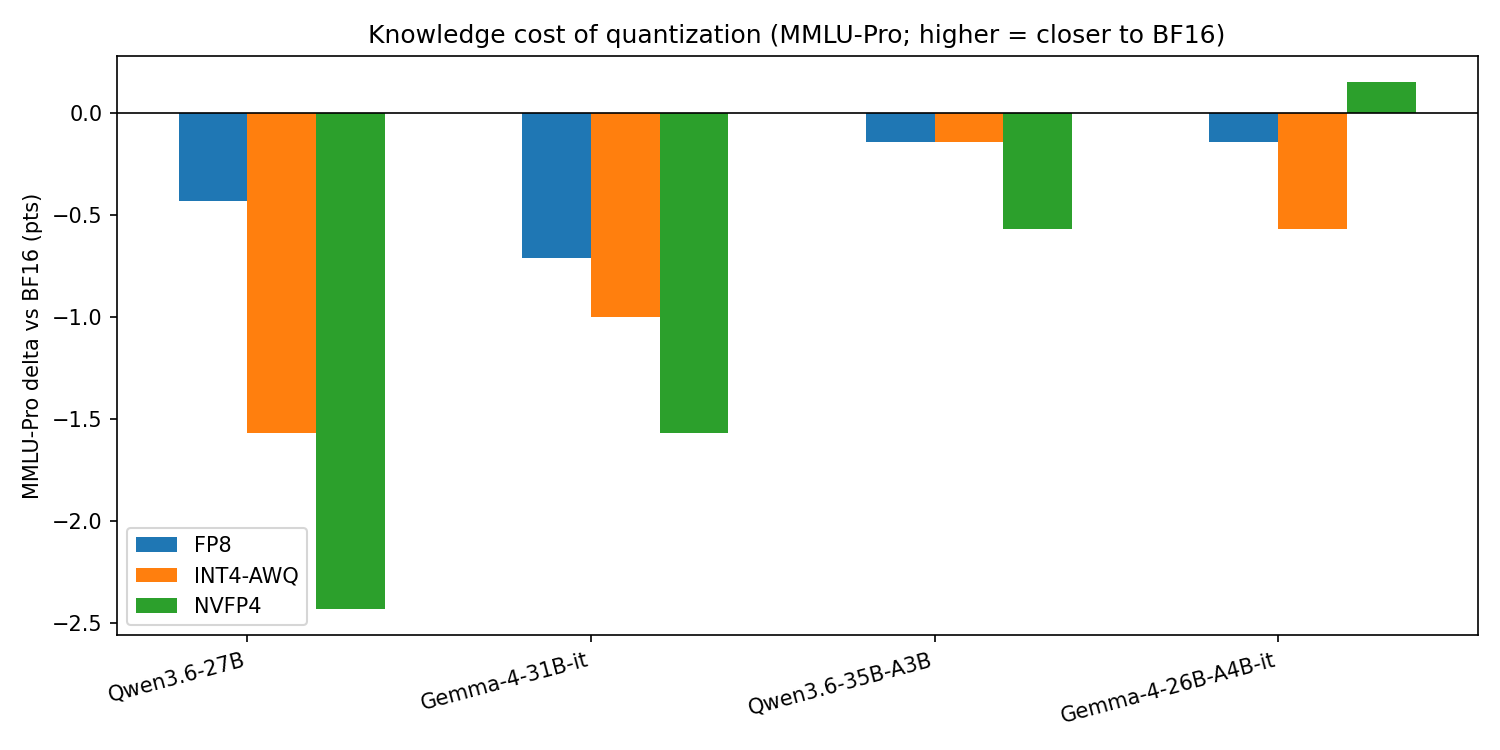
1. The quality cost of 4-bit is small, and it lives in knowledge — not math or code. MMLU-Pro is the only task that moves monotonically with precision. Everywhere else the arms sit at a ceiling: GSM8K 95–98%, HumanEval/MBPP within run-to-run noise of their BF16 reference, occasionally above it. Table 3 isolates the MMLU-Pro cost. Averaged across all five tasks, NVFP4 costs the dense models 0.6 points each and the Qwen-MoE 0.5 — small enough that for most deployments the format is free.
Table 3 — MMLU-Pro delta vs the same model’s BF16 (percentage points). The knowledge cost of 4-bit.
| Model | FP8 | INT4-AWQ | NVFP4 |
|---|---|---|---|
| Qwen3.6-27B (dense) | −0.4 | −1.5 | −2.4 |
| Gemma-4-31B-it (dense) | −0.7 | −1.0 | −1.6 |
| Qwen3.6-35B-A3B (MoE) | −0.1 | −0.1 | −0.5 |
| Gemma-4-26B-A4B-it (MoE) | −0.1 | −0.6 | +0.2 |
2. NVFP4 and INT4-AWQ are a wash at equal ~½ byte/param — and the recipe is the lever. The only place INT4-AWQ clearly beats NVFP4 is the Qwen-dense (−1.5 vs −2.4 on MMLU-Pro) — and that NVFP4 arm is the community unsloth quant that takes the whole language model to four bits, attention included. The three official NVIDIA NVFP4 arms keep more of attention in higher precision (§3.3), and there the two formats are within a point everywhere; on the Gemma-MoE, NVFP4 (+0.2) edges INT4-AWQ (−0.6). The format does not decide the outcome — what the recipe chooses to protect does.
3. Mixture-of-Experts absorbs four bits better than dense. The two MoE families lose ≤0.6 MMLU-Pro points to NVFP4 (Qwen-MoE −0.5, Gemma-MoE +0.2) against −2.4 and −1.6 for the dense pair. With only ~3–4B of ~26–35B parameters active per token, the quantization error that matters is spread across a large, redundant expert pool and averages down.
4. Instruction-following splits on thinking, not precision. IFEval cleaves the matrix cleanly
in two: every Qwen arm scores ~30, every Gemma arm ~90 — on the identical protocol. The cause is
thinking mode. Qwen emits a <think> block before answering, and that reasoning violates the
strict constraints IFEval scores (exact word counts, “no commas,” wrap-in-quotes); Gemma answers
directly and complies. Strict and loose accuracies are within 0.2 of each other, so this is not a
markup artifact — the model reasons itself out of following the instruction. Quantization moves it
by ≤1 point within either family. This is the sharpest “reasoning creep” in the study, and it is a
property of the decoding mode, not the number format.
4.1 Cross-validation against NVIDIA
For the official NVIDIA NVFP4 arms we compare our measured BF16→NVFP4 delta to the delta implied by NVIDIA’s published numbers on the benchmarks that overlap our suite. Absolute scores differ by protocol (we run thinking-on, chat-templated); the credibility anchor is whether the delta agrees.
Table 4 — our BF16→NVFP4 delta vs NVIDIA’s published delta.
| Model | Benchmark | ours BF16 | ours NVFP4 | ours Δ | NVIDIA BF16 | NVIDIA NVFP4 | NVIDIA Δ | |Δ−Δ| |
|---|---|---|---|---|---|---|---|---|
| Gemma-4-31B-it | MMLU-Pro | 86.0 | 84.4 | −1.57 | 85.25 | 84.94 | −0.31 | 1.26 |
| Qwen3.6-35B-A3B | MMLU-Pro | 83.1 | 82.6 | −0.57 | 85.6 | 85.0 | −0.60 | 0.03 |
| Gemma-4-26B-A4B-it | MMLU-Pro | 82.7 | 82.9 | +0.15 | 85.0 | 84.8 | −0.20 | 0.35 |
| Gemma-4-26B-A4B-it | IFEval | 89.5 | 89.8 | +0.37 | 96.6 | 96.4 | −0.20 | 0.57 |
Three of the four deltas agree to within 0.6 points; the Qwen3.6-35B-A3B — the arm whose lm_head
we rebuilt by hand — reproduces NVIDIA’s published NVFP4 delta to 0.03 points, which is the
single best evidence that both the substitution and the pipeline are sound. The one looser row is
the Gemma-4-31B dense (1.26): our BF16 reads 86.0 against NVIDIA’s 85.25 and our NVFP4 lands a
little lower, so the gap is in the absolute anchors, not a divergent trend. Independent measurement,
made with no access to NVIDIA’s harness, lands on NVIDIA’s own deltas — which is exactly what a
trustworthy quantization benchmark should do.
4.2 Test-retest — how stable are these numbers?
Every score above is a single run, so before reading anything into sub-point deltas we re-ran the
entire matrix end-to-end — identical pinned weights, identical engine, a fresh generation
cache — and compared it score for score (reproducibility/test_retest.md). Across all 80 (arm,
task) scores the mean absolute drift is 0.35 points, and the shape is exactly what greedy
decoding on non-deterministic kernels predicts:
- GSM8K is essentially exact (max drift 0.83) — the arithmetic chain converges to the same final answer regardless of floating-point jitter.
- MMLU-Pro is the noisiest, ≤1.7 points — comparable to its own ±1.3-point sampling stderr — because cutlass/cudagraph reductions occasionally flip the arg-max on a borderline item.
- Coding swings up to ~3 points: pass@1 is binary per problem, so a handful of flips moves several points; the largest is the Gemma-MoE arm — the same degenerate-decoding task §4 already sets aside.
- Throughput is far steadier — every arm’s single-stream decode rate reproduced within 0.6% (mean 0.22%).
This fixes the resolution of the study. The dense NVFP4 costs (−1.6 to −2.4 MMLU-Pro points) sit
comfortably above the ~1-point floor and are real; the MoE deltas (≤0.6) sit inside it and read as
indistinguishable from BF16 — which is also how the cross-validation against NVIDIA reads them.
We therefore report single-run numbers plus this measured floor, not a multi-seed average; the full
second run is committed under results-rerun/.
5. Results — throughput & memory
Measured at --max-num-seqs 1, 64k max context, median of three after a warmup pass. Decode is
tokens/s at a 128-token prompt; TTFT is time-to-first-token (the prefill cost).
Table 5 — single-stream throughput & footprint.
| Model (type) | Format | Size GB | Decode tok/s | TTFT @128 (s) | TTFT @16k (s) |
|---|---|---|---|---|---|
| Qwen3.6-27B (dense) | BF16 | 55.6 | 26.7 | 0.063 | 3.95 |
| FP8 | 30.9 | 48.8 | 0.074 | 2.56 | |
| INT4-AWQ | 21.9 | 69.0 | 0.064 | 3.97 | |
| NVFP4 | 26.4 | 55.6 | 0.108 | 1.94 | |
| Gemma-4-31B-it (dense) | BF16 | 62.6 | 22.3 | 0.052 | 0.087 |
| FP8 | 33.3 | 42.0 | 0.032 | 0.064 | |
| INT4-AWQ | 20.5 | 63.9 | 0.029 | 0.058 | |
| NVFP4 | 32.7 | 40.8 | 0.059 | 0.079 | |
| Qwen3.6-35B-A3B (MoE) | BF16 | 71.9 | 168.6 | 0.075 | 0.80 |
| FP8 | 37.5 | 221.4 | 0.082 | 0.55 | |
| INT4-AWQ | 25.5 | 194.2 | 0.075 | 0.69 | |
| NVFP4 ‡ | 23.5 | 226.3 | 0.098 | 0.58 | |
| Gemma-4-26B-A4B-it (MoE) | BF16 | 51.6 | 151.7 | 0.031 | 0.051 |
| FP8 | 28.7 | 200.1 | 0.034 | 0.053 | |
| INT4-AWQ | 17.2 | 222.0 | 0.028 | 0.047 | |
| NVFP4 | 18.8 | 179.8 | 0.031 | 0.051 |
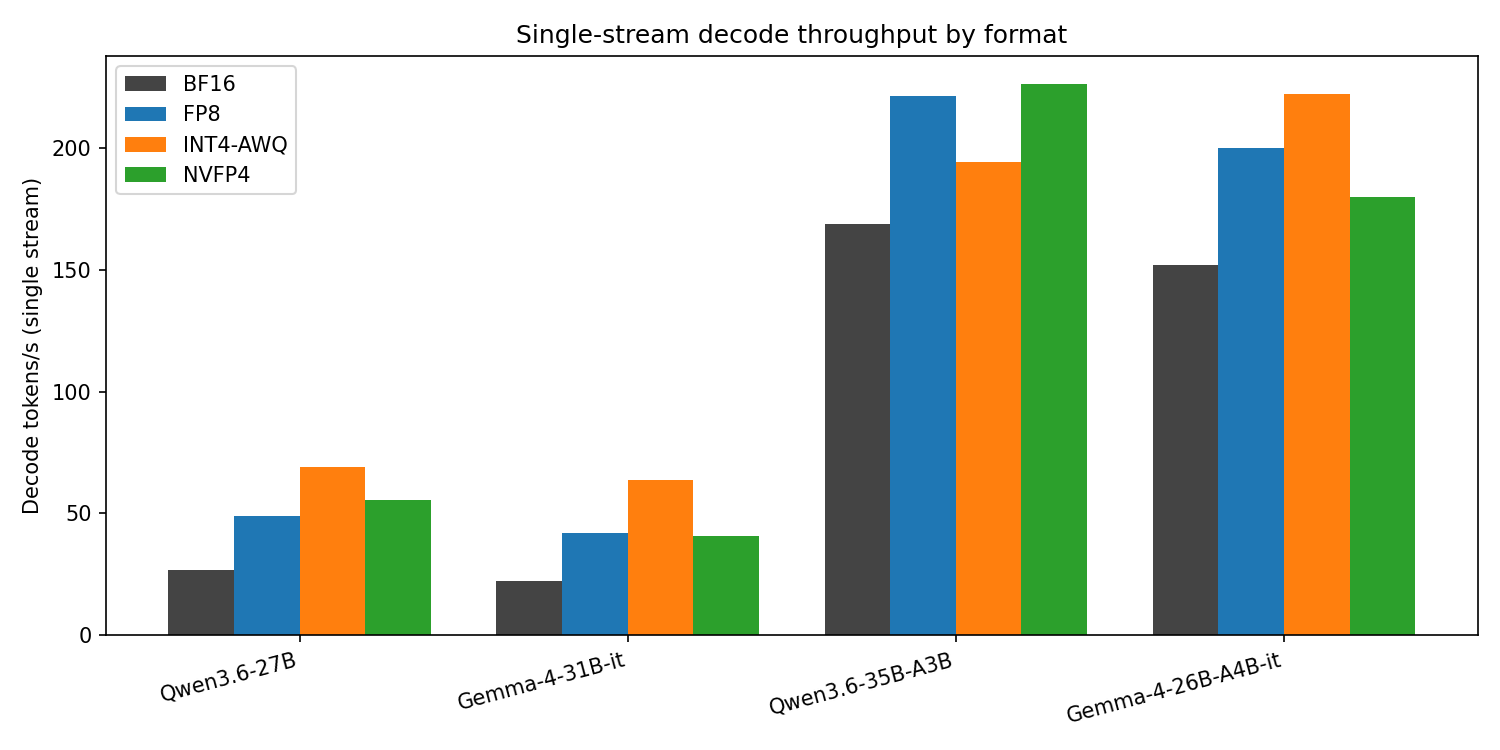
1. Architecture is the throughput story. The MoE arms decode at 152–226 tok/s, the dense arms at 22–69 — a 3–7× gap at matched precision, because only ~3–4B of 26–35B parameters are active per token. No quantization choice comes close to moving the needle this far.
2. Four bits buys decode speed. Single-stream decode is memory-bandwidth-bound, so halving the bytes per weight roughly doubles it: the dense models go from 22–27 tok/s at BF16 to 64–69 at INT4-AWQ (~2.6×), with FP8 (~1.8×) in between.
3. There is no universal “fastest 4-bit.” INT4-AWQ’s mature Marlin kernels lead on three of the four models (both dense, plus the Gemma-MoE), but NVFP4’s fused-MoE cutlass kernel takes the Qwen-MoE outright (226.3 vs 194.2 tok/s). The takeaway is not “X is faster” but that on this SM120 hardware INT4-AWQ is the safe bet for raw single-stream decode while NVFP4 is already competitive — and leads where its kernel path is exercised.
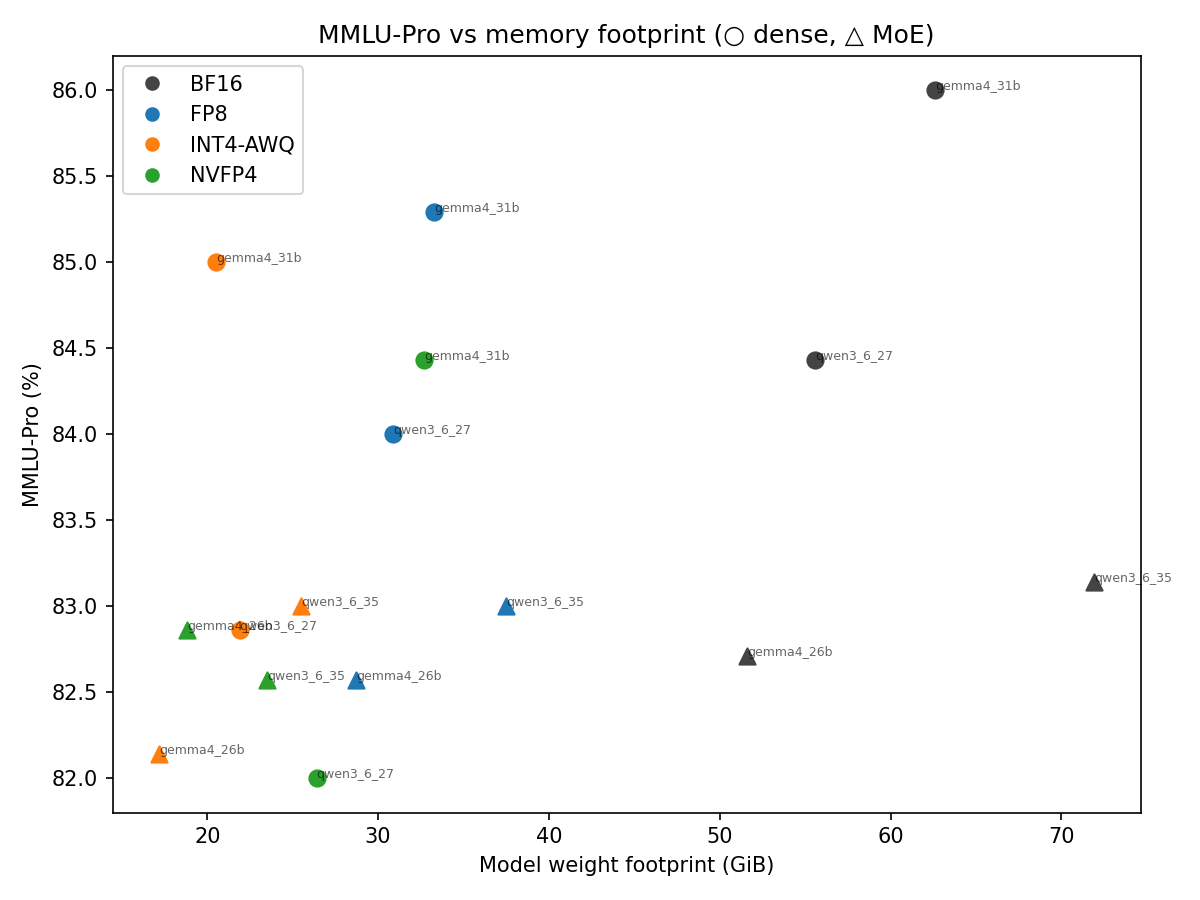
4. Footprint is where NVFP4 is unambiguous. It is the smallest or near-smallest weight load in every family (18.8 GB for the Gemma-MoE, 23.5 for the Qwen-MoE), edging even INT4-AWQ on the Qwen arms. Every four-bit arm here fits its weights plus a 64k KV-cache inside 96 GB comfortably; only the 72 GB BF16 MoE reference is tight.
5. Prefill (TTFT). At a 128-token prompt every arm answers in under 0.11 s. At 16k the spread is governed by attention architecture, not precision, and we flag rather than over-read it: the dense Qwen pays a full 2–4 s prefill, its MoE sibling ~0.6 s (3B active), and Gemma’s windowed attention keeps long-prompt prefill near-flat (<0.1 s). These are not apples-to-apples across model families and we draw no quantization conclusion from them.
6. Discussion — what to actually run on a 96 GB Blackwell box
Two levers govern a local deployment, and quantization is the smaller of them.
Architecture first. On a single-user workstation the gap between dense and MoE is not subtle: the MoE arms decode at 152–226 tok/s, the dense arms at 22–69. A 35B-parameter MoE that activates ~3B per token is both faster and cheaper than a 27B dense model, at equal-or-better quality. For local agentic work — short prompts, low concurrency, latency a human feels — the first decision is “MoE,” and only then “which precision.”
Then precision, where the verdict is nuanced. At an equal ~½ byte per parameter the two four-bit formats trade blows. On quality they are within a point once the recipe is sane — the three official NVIDIA NVFP4 arms sit within 1.0 MMLU-Pro point of their INT4-AWQ siblings, and on the Gemma-MoE NVFP4 is actually ahead. On single-stream decode, the mature INT4-AWQ Marlin kernels are usually the faster of the two on this hardware (e.g. 69.0 vs 55.6 tok/s on the Qwen-dense). NVFP4’s structural advantages — the smallest weight footprint and the highest arithmetic throughput on the tensor cores — pay off in the regimes this single-stream study deliberately did not stress: large batches and long prefills. The honest workstation takeaway is that INT4-AWQ is the pragmatic default today, and NVFP4 is the forward bet — it already wins on memory, and it wins on compute as batch size grows and the SM120 kernels mature.
When FP8 is the safer call. FP8 carries the smallest quality cost of any compression here — its MMLU-Pro delta runs −0.1 to −0.7 and it never breaks a task — at ~1 byte per parameter and ~1.8× the BF16 decode speed. If you have the VRAM and want to forget you quantized at all, FP8 is the conservative choice. Four bits is for when memory or speed is the binding constraint.
The memory picture. Every four-bit arm here fits its weights plus a 64k-token KV-cache inside 96 GB with room to spare; the smallest — Gemma-MoE at 17–19 GB — leave most of the card free for batching or a second model. The only tight arm is the 72 GB BF16 MoE reference, which is exactly the case quantization exists to solve.
Bottom line. On a 96 GB Blackwell workstation running one agent at a time: reach for a 4-bit MoE. Take INT4-AWQ if you want maximum tokens per second today; take the official NVFP4 if you want the smallest footprint and the format the hardware was built for. Either way, the quality you give up is, for most work, in the noise.
7. Limitations
We state these plainly so the numbers are read for exactly what they are.
- Recipe heterogeneity (§3.3). Each “FP8/INT4/NVFP4” arm is the most-deployed quant for that model, and the recipes protect different layers. We report per-format effects and same-model deltas, not a pure number-format isolation.
- Within-model deltas are the robust quantity. Absolute scores depend on the
generative protocol and on each model’s native chat behaviour (Qwen reasons in
<think>blocks, Gemma answers directly), so cross-model absolute comparisons are indirect. The quantization delta (arm vs its own BF16) is what we trust, and what the cross-validation against NVIDIA checks. - Coverage caps. MMLU-Pro is scored on ~700 items (50 per subject × 14 subjects, identical across arms) and GSM8K on 600; GPQA-Diamond is held out (HF-gated dataset); AIME-2025 is dropped (greedy single-pass floors at 0). Tiny sub-1% deltas are therefore at the edge of resolution — we lean on the cross-validation and the aggregate across tasks.
- Single GPU, single run per (arm, task) — but we measured the run-to-run floor by re-running the whole matrix (§4.2): mean absolute drift 0.35 points across all 80 scores (GSM8K essentially exact, MMLU-Pro ≤1.7 within stderr, coding up to ~3, throughput ±0.6%). We report single-run numbers plus that measured floor, not a multi-seed average.
- KV-cache precision varies by arm (the NVFP4 arms ship FP8 KV-cache). This is part of the deployed configuration we deliberately measure, but it means arms differ in more than just weight precision.
- Engine. vLLM 0.22.1 with JIT-compiled FlashInfer SM120 kernels (the NVFP4 cutlass
GEMM and the fused-MoE GEMM); building them on this driver-only host required pointing
CUDA_HOMEat the bundled CUDA-13 toolkit and adding NVRTC/cuBLAS dev symlinks — all scripted in the repo. Numerical parity is assumed, checked only indirectly via cross-validation. - Coding is executed in a permissive local sandbox; multimodal models are evaluated on their text path only.
- Gemma-4-26B-A4B (MoE) coding is a decoding artifact (§4, †), not a capability or quantization signal — greedy decoding drives this low-active-parameter model into repetition collapse on open-ended code, uniformly across all four formats. We exclude it from that model’s quantization deltas.
- One NVFP4 arm runs
lm_headin BF16 (§4, ‡). vLLM 0.22.1 cannot construct the quantizedlm_headthe NVIDIA Qwen-MoE NVFP4 checkpoint ships, so we dequantized that one tensor to BF16 and left every expert and attention layer bit-exact NVFP4. The arm’s MMLU-Pro delta matches NVIDIA’s published figure to 0.03 pts, so the effect is immaterial — but it is a deviation from the pure artifact and we name it.
8. What these benchmarks measure — and what comes next
A scope disclaimer, stated plainly. Nothing in this study measures whether these models are good — useful, reliable, pleasant to actually work with. We measured one narrow thing: how a numeric format moves a model’s score on the standardized academic suites (MMLU-Pro, GSM8K, IFEval, HumanEval, MBPP) the field has agreed to compare on. Those suites are, in our opinion, showing their age. Half of them sit at a ceiling here — GSM8K at 95–98%, the coding sets within run-to-run noise of their BF16 reference (§4) — so they no longer separate frontier-class models; they reward single-turn question-answering rather than the multi-step, tool-using behaviour a local agent actually performs; and a model can top all five and still fail the first real task you hand it. We run them because they are the common yardstick and because they let us cross-validate against NVIDIA (§4.1), not because we believe they capture practical capability. Read this report as exactly what it is: a measurement of format-induced quality change, not a verdict on which model to trust with real work.
And yet — the result that stopped us. Hold that saturation complaint next to the absolute numbers. Our Gemma-4-31B-it scores 84.4 on MMLU-Pro at 4-bit NVFP4 (Table 2), and every Qwen and Gemma arm lands between 82 and 86 — with the smallest four-bit arms (the Gemma-MoE, 17–19 GB) fitting a single 24 GB consumer card. On that same benchmark, GPT-4o — the strongest model in MMLU-Pro’s own paper — scores 72.6 (Wang et al., NeurIPS 2024). A frontier model of that generation carried a training-compute bill in the tens of millions of dollars: Stanford’s AI Index estimated GPT-4’s at roughly $78 million (Epoch AI’s amortized figure is ~$40M) (Stanford HAI AI Index 2025). So a quantized model that runs on one GPU under a desk now sits ten-plus points above a system that cost tens of millions of dollars to train, on the very benchmark that system helped make a standard. The comparison crosses harnesses — different shot count, item subset and protocol — so read the exact margin as directional; but the gap is far larger than any protocol difference could close. That is the real headline of the four-bit era, and it is precisely why the academic suites feel outdated: the open, quantized, runs-on-your-own-hardware models have already caught the frontier on these tests.
What comes next. The honest way to answer the question this study deliberately cannot — which model is actually best for a local agent, and for local agentic coding? — is to stop scoring trivia and start scoring work. Our next benchmarks move to agentic evaluation: τ-bench (Sierra’s tool-use-and-policy benchmark, where a model must hold a multi-turn conversation and call tools correctly under explicit rules) and SWE-bench (resolve real GitHub issues against real repositories, graded by the projects’ own test suites). Those measure what a local agent is actually hired to do. Same hardware, same four formats, same reproducible discipline — and we will publish the numbers nobody else does there, too.
9. Conclusion
The number nobody publishes is the independent one: how much a real, downloaded quantization actually costs on real hardware, measured by someone with no stake in the answer. For four-bit on Blackwell, that number is small — a fraction of a point of knowledge, nothing on math or code — and it is dwarfed by the architectural choice between dense and MoE. NVFP4 is not a free lunch over INT4-AWQ on a single-stream workstation today; it is the better-engineered bet — smallest in memory now, and built for the throughput regimes that arrive with scale. Blackwell made the nibble cheap. These measurements say you can spend it.
Appendix A — full configuration & pinned SHAs
See configs/models.yaml (committed). Engine lockfile: env/requirements.lock.txt.
Appendix B — environment baseline
See repository CLAUDE.md and results/ raw logs.
Sources
Every in-house metric traces to a committed run log under results/; the external numbers and
tools this report leans on are below.
- NVIDIA published NVFP4 accuracy (cross-validation, §4.1 / Table 4) — transcribed from the
official NVIDIA Model Optimizer model cards:
Gemma-4-31B-IT-NVFP4,
Qwen3.6-35B-A3B-NVFP4,
Gemma-4-26B-A4B-NVFP4. The transcribed
bf16/nvfp4figures and modelopt versions are recorded per arm inconfigs/models.yaml. - GPT-4o MMLU-Pro = 72.6 (§8) — Wang et al., MMLU-Pro: A More Robust and Challenging Multi-Task Language Understanding Benchmark, NeurIPS 2024 (arXiv:2406.01574).
- GPT-4 training-compute cost ≈ $78 M (§8) — Stanford HAI, 2025 AI Index Report, R&D chapter (Epoch AI’s amortized-hardware estimate is ~$40 M).
- Evaluation harness — EleutherAI lm-evaluation-harness, generative protocol; task suite MMLU-Pro, GSM8K, IFEval, HumanEval, MBPP (task definitions as shipped by the harness).
- Engine — vLLM 0.22.1 and
FlashInfer 0.6.11 (the SM120 NVFP4 and fused-MoE
kernels); exact lockfile in
env/requirements.lock.txt. - Model artifacts — every arm’s Hugging Face repo and pinned commit SHA, with per-layer recipe
and 30-day download count, is listed in
configs/models.yaml.